The Railing at the Threshold
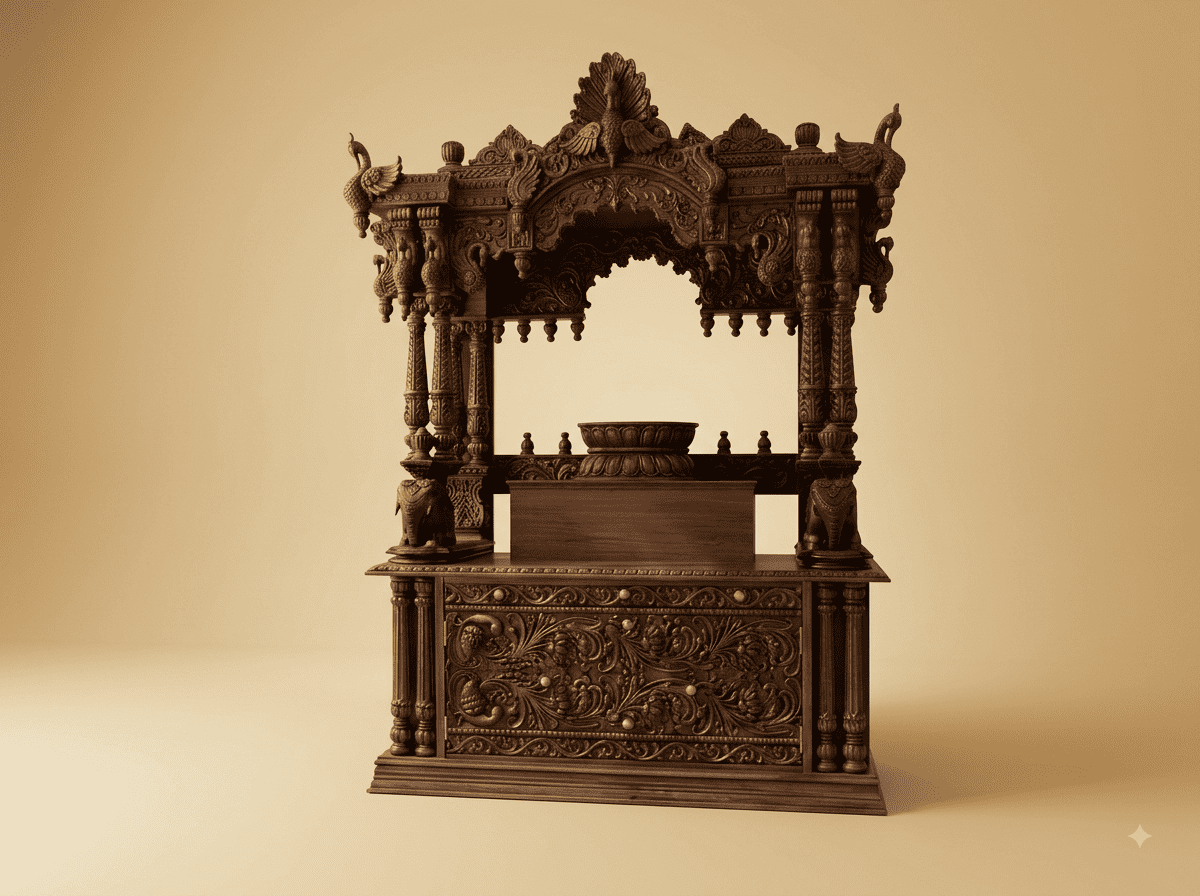
In a stone temple a low balustrade runs across the front of the sanctum. It is not decoration; it marks the threshold between the space where the deity stands and the space where the worshipper does, and the eye reads that boundary before anyone explains it. Domestic mandirs almost always leave it out, because it is fiddly to make and nobody misses what they have never seen. Including it gives a home mandir something that most of them lack: a sense that the platform is a defined place rather than simply a shelf.
It also does real work. An open-fronted mandir puts the platform at around chest height with nothing along its front edge, and anything set near that edge, a diya, a small murti, supari, a matchbox, can be knocked off by a sleeve when someone reaches past. A turned railing stops that. The barley-twist columns beside it are the other slow element on this piece: each is turned on a lathe and then carved by hand into a spiral that runs continuously from base to capital, which cannot be convincingly imitated with an applied moulding because the pitch of the twist breaks wherever sections join. Every part here is carved and polished by hand by master Indian artisans.
 Ask Price On WhatsApp