The Story Behind This Mirror
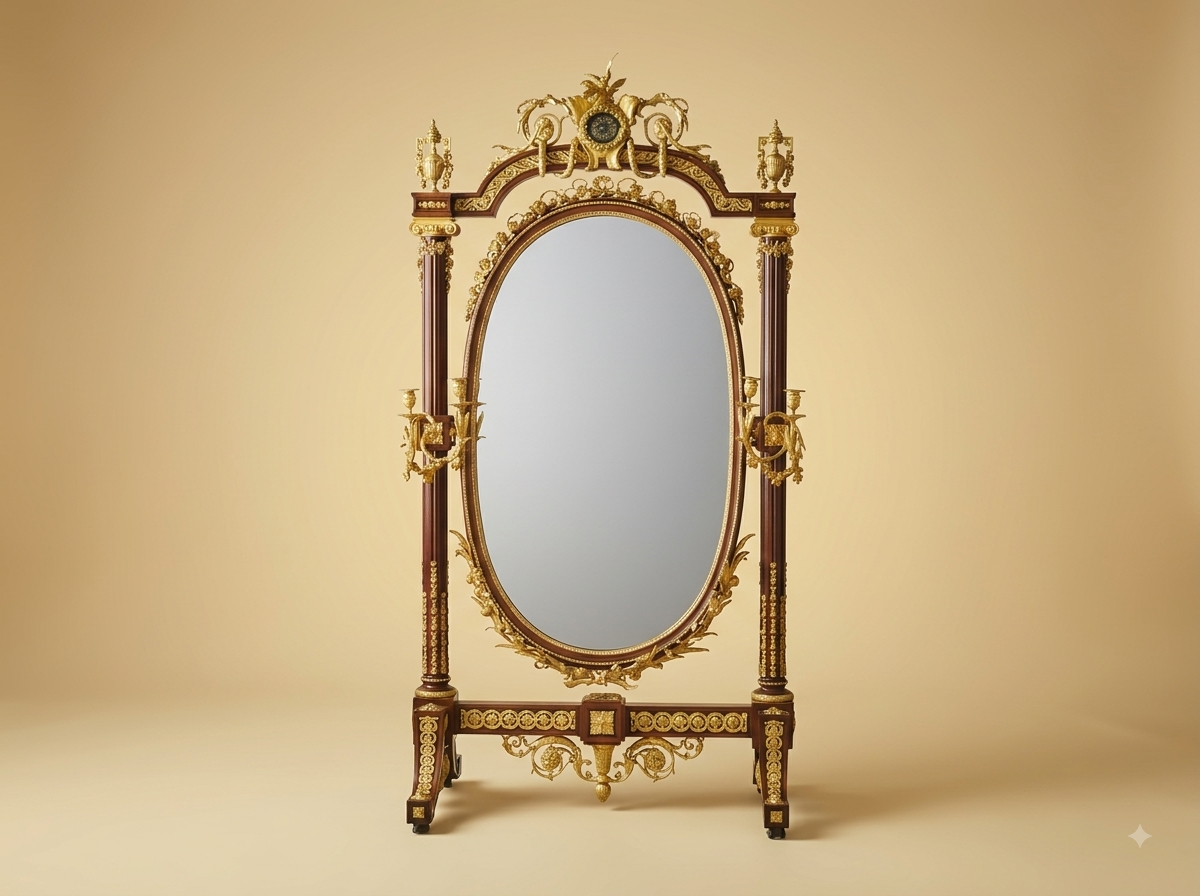
A cheval is furniture before it is decoration, and that changes how it is made. The columns, the feet and the stretcher form a structure that has to stand steady on an uneven floor, carry a heavy plate, and survive being pushed across a room - so the joinery is cut to furniture standards, dry-fitted and tested under load before any carving or gilding begins.
The columns are turned first, then fluted by hand along their length, which is slow work because a flute that wanders is visible from every angle on a round section. The pivot mechanism is fitted and adjusted so the plate holds any angle it is set to without drifting - too loose and it creeps, too tight and it strains the columns. The urns are turned and then carved. The candle arms are shaped, and the foliate mounts around the oval and across the cornice are carved separately and applied.
Only then is the piece finished: the timber brought to its deep warm tone, the gilt laid by hand on the carved mounts alone and rubbed back at the high points, and the bevelled oval plate fitted and balanced last.
 Ask Price On WhatsApp