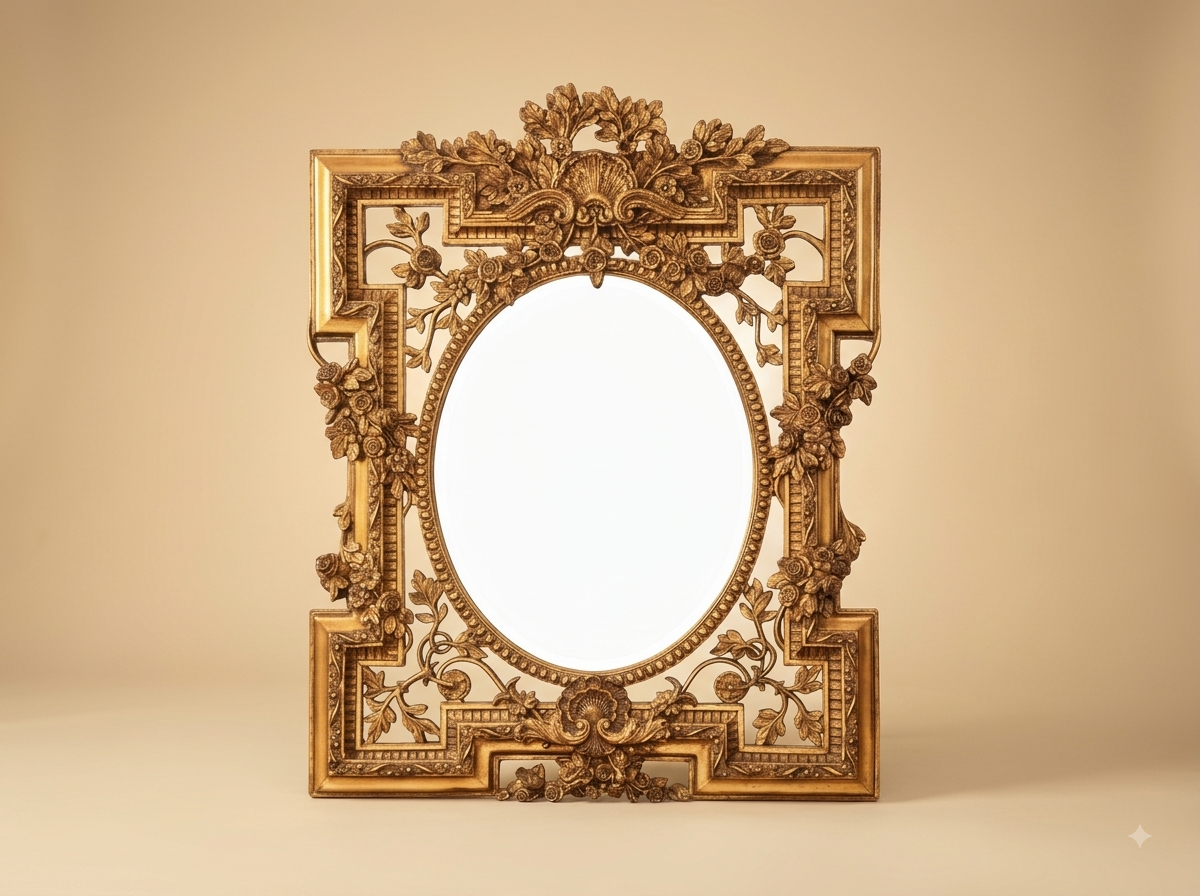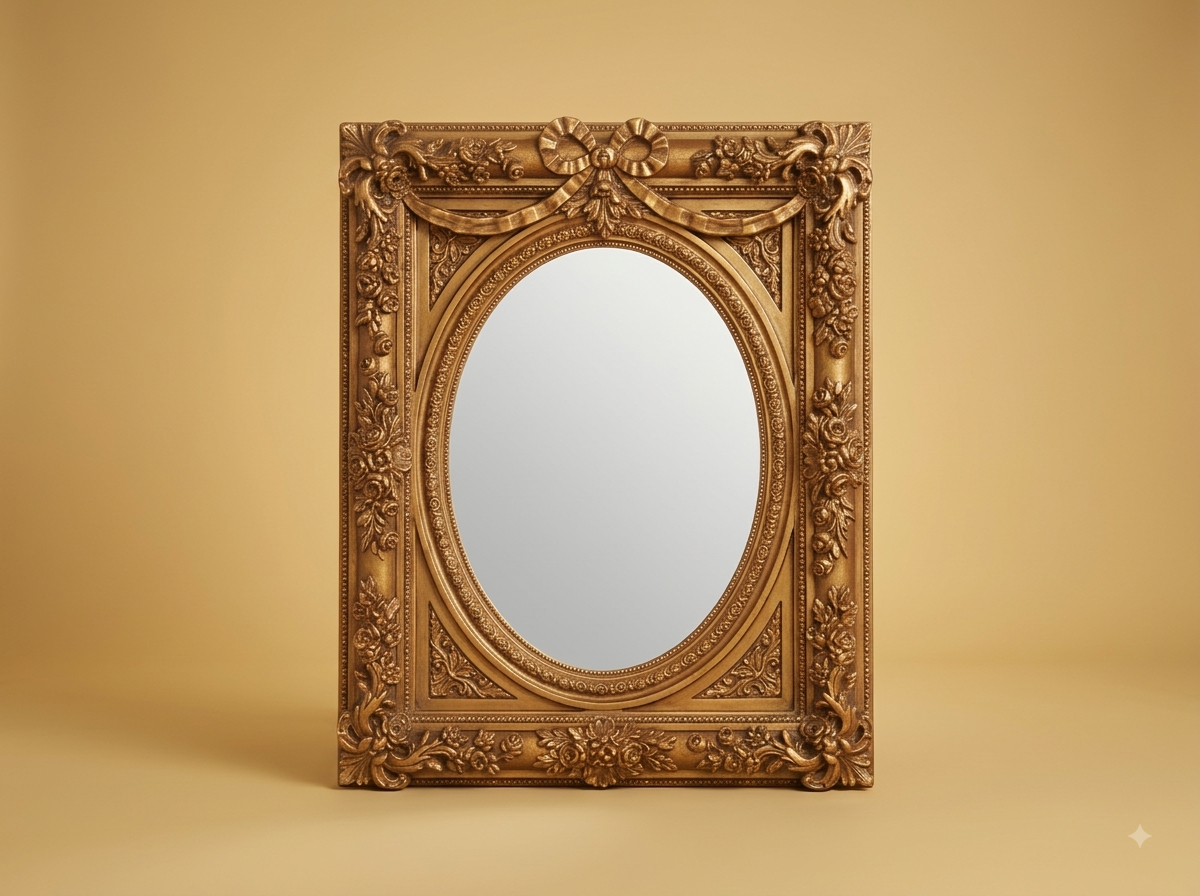
Putting an oval inside a rectangle leaves four corner panels, and how those are carved decides whether the two shapes get along.
The obvious approach is to treat each corner as a corner: put a symmetrical rosette or a square motif in it, aligned to the frame. It looks tidy on a drawing. On the finished mirror it fights, because now the corner ornament is announcing the rectangle at exactly the point where the eye is trying to follow the oval round.
So the sprays here are set out from the oval instead. Each grows out of the outer corner and curves inward, with its leaves and flowers following the ellipse - so the ornament runs alongside the curve rather than across it.
The four are laid out as two mirrored pairs, upper and lower, rather than four copies of the same spray - because the oval is taller than it is wide, and a spray that sits comfortably in the top corner is slightly too long for the bottom one.
The effect is that the corners lead the eye around the oval, and the rectangle becomes a background rather than a competitor.
 Ask Price On WhatsApp